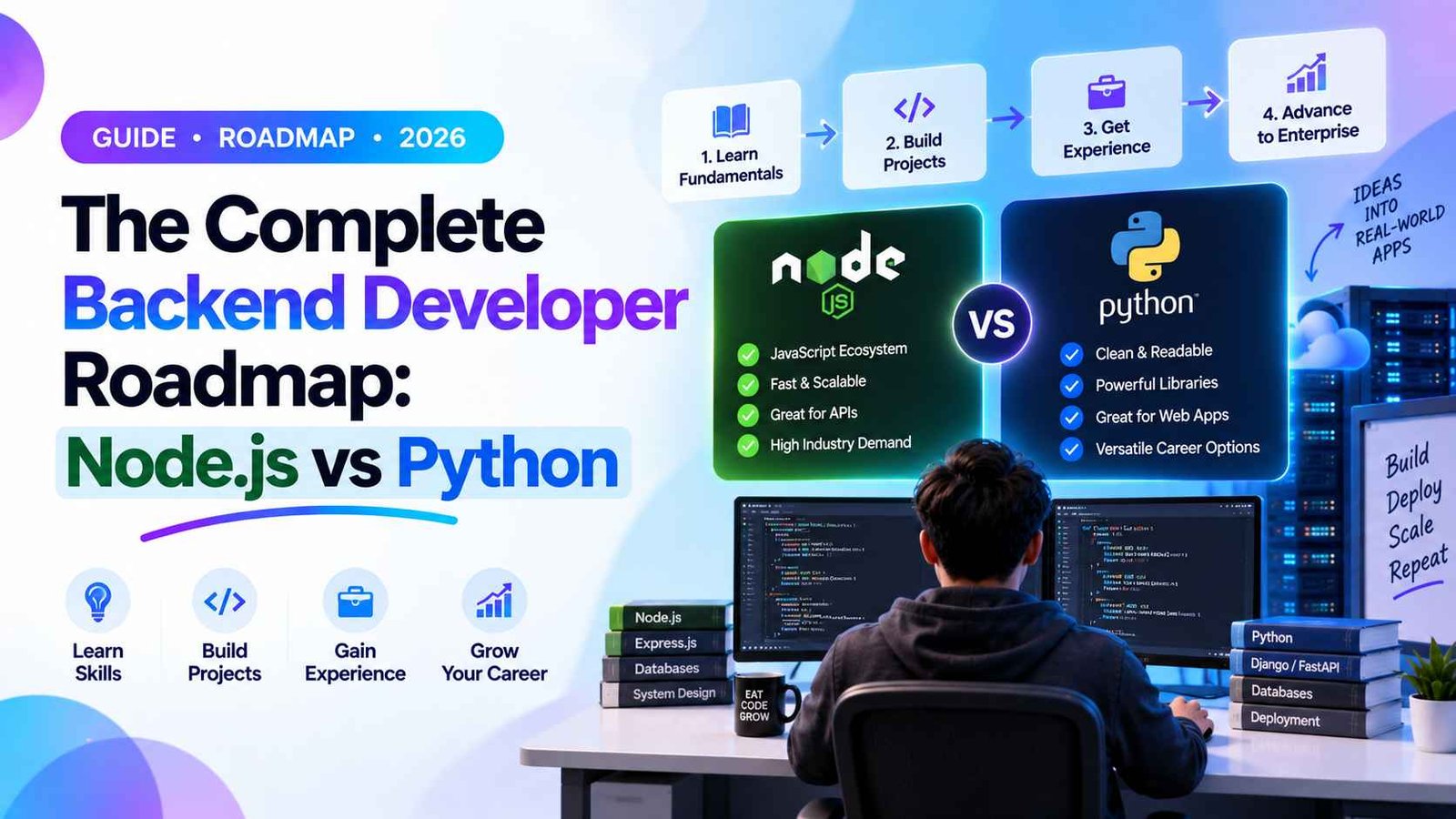
If your goal is becoming a backend developer in 2026, both Node.js and Python are excellent choices.
Neither is universally better.
The right choice depends on:
- your career goals
- the kind of software you want to build
- companies you want to work for
- your learning style
- long-term specialization
This guide explains not only which technology to choose but also exactly what you should learn after making that decision.
By the end, you’ll know:
- when Node.js is the better option
- when Python wins
- which roadmap gets you hired faster
- how professional backend systems are actually built
- Step 1: Learn Programming Fundamentals
- Step 2: Master HTTP
- Step 3: Learn REST API Design
- Step 4: Learn Databases
- Step 5: Learn Git
- Stage 1 — Learn Modern JavaScript
- Variables
- Functions
- Objects
- Arrays
- Asynchronous JavaScript
- Stage 2 — Learn Node.js Fundamentals
- Stage 3 — Learn Express.js
- Stage 4 — Database Integration
- Stage 5 — Move Beyond Express
- Stage 1 — Learn Python Fundamentals
- Variables and Data Types
- Functions
- Object-Oriented Programming (OOP)
- Exception Handling
- Virtual Environments
- Flask
- Django
- FastAPI
- Authentication
- Authorization
- API Security
- Caching
- Background Jobs
- Docker
- CI/CD
- Cloud Deployment
- Monitoring and Logging
- Choose Node.js if you want to:
- Choose Python if you want to:
- Beginner Projects
- Intermediate Projects
- Advanced Projects
- Frequently Asked Questions
- Is Node.js faster than Python?
- Is Python easier to learn than Node.js?
- Can I learn both Node.js and Python?
- Which has more jobs?
- Is backend development still a good career with AI?
- Do I need a computer science degree?
- Should I learn Docker before applying for jobs?
- Which framework is best for beginners?
Node.js vs Python at a Glance
| Feature | Node.js | Python |
|---|---|---|
| Language | JavaScript | Python |
| Runtime | V8 Engine | CPython |
| Learning Difficulty | Moderate | Easy |
| Beginner Friendly | ⭐⭐⭐⭐☆ | ⭐⭐⭐⭐⭐ |
| Performance | Excellent | Good |
| Concurrency | Excellent | Very Good |
| Large Enterprise Apps | Excellent | Excellent |
| APIs | Excellent | Excellent |
| AI & Machine Learning | Limited | Outstanding |
| Data Science | Weak | Industry Standard |
| Real-time Applications | Excellent | Good |
| Microservices | Excellent | Excellent |
| Community | Massive | Massive |
| Job Market | Very Strong | Very Strong |
Quick Recommendation
Choose Node.js if you want to build:
- SaaS platforms
- Chat applications
- Real-time dashboards
- Collaborative software
- Startup products
- Full-stack JavaScript applications
Choose Python if you’re interested in:
- AI
- Machine Learning
- Data Engineering
- Automation
- Scientific computing
- Enterprise web applications
- Backend APIs with future AI integration
What Does a Backend Developer Actually Do?
Many beginners think backend development simply means writing APIs.
Professional backend engineering is much broader.
A backend developer designs and maintains everything users don’t see.
That includes:
- business logic
- databases
- authentication
- authorization
- API design
- caching
- file storage
- payment processing
- background jobs
- logging
- monitoring
- security
- server deployment
- scaling infrastructure
Imagine ordering food through an app.
When you tap Order, dozens of backend operations happen.
The backend:
- validates your login
- checks restaurant availability
- verifies inventory
- calculates taxes
- applies coupons
- processes payment
- creates an order
- notifies the restaurant
- tracks delivery
- stores order history
- sends confirmation emails
The frontend only displays results.
The backend performs all the work.
The Complete Backend Roadmap Before Choosing Any Language
Regardless of whether you choose Node.js or Python, every backend developer should master the same core concepts.
Think of programming languages as tools.
The engineering principles remain largely identical.
Step 1: Learn Programming Fundamentals
Don’t rush into frameworks.
Understand programming first.
Topics include:
- variables
- loops
- functions
- objects
- arrays
- recursion
- error handling
- modules
- file handling
Without these fundamentals, frameworks become confusing.
Step 2: Master HTTP
Every backend application communicates through HTTP.
Understand:
- HTTP methods
- request lifecycle
- response codes
- headers
- cookies
- sessions
- caching
- compression
Know the difference between:
- GET
- POST
- PUT
- PATCH
- DELETE
Understand why each exists.
Step 3: Learn REST API Design
REST APIs remain one of the most requested backend skills.
Learn:
- endpoints
- resources
- versioning
- pagination
- filtering
- sorting
- authentication
- rate limiting
Example:
GET /users

GET /users/25

POST /users

PUT /users/25

DELETE /users/25
Simple naming conventions make APIs predictable.
Step 4: Learn Databases
A backend without databases is incomplete.
Understand relational databases:
- PostgreSQL
- MySQL
Learn:
- tables
- joins
- indexes
- normalization
- constraints
- transactions
Then study NoSQL databases like:
- MongoDB
- Redis
Understand when each makes sense.
Step 5: Learn Git
Professional development is impossible without version control.
Understand:
- commits
- branches
- merge conflicts
- pull requests
- rebasing
- GitHub workflow
Every company expects this knowledge.
Node.js Backend Roadmap
Node.js is not a programming language.
It is a JavaScript runtime built on Google’s V8 engine that allows JavaScript to run outside the browser.
The biggest advantage?
You can write both frontend and backend using JavaScript.
Many startups prefer this because developers can work across the full stack.
Stage 1 — Learn Modern JavaScript
Before touching Express or NestJS, master JavaScript itself.
Important topics include:
Variables
Understand:
- let
- const
- scope
- hoisting
Functions
Learn:
- arrow functions
- callbacks
- higher-order functions
- closures
Objects
Understand:
- object literals
- prototypes
- classes
- inheritance
Arrays
Master:
- map()
- filter()
- reduce()
- find()
- some()
- every()
These methods appear in almost every production project.
Asynchronous JavaScript
This is where many beginners struggle.
Learn carefully:
- callbacks
- promises
- async/await
- event loop
- microtasks
- macrotasks
Understanding asynchronous programming is one of the biggest differences between a beginner and a professional Node.js developer.
Stage 2 — Learn Node.js Fundamentals
Once JavaScript feels comfortable, move into Node.
Learn:
- modules
- npm
- package management
- environment variables
- streams
- buffers
- file system
- path module
- events
- process
- child processes
Build small command-line applications before creating web servers.
Stage 3 — Learn Express.js
Express remains one of the easiest ways to build APIs.
Start with:
- routing
- middleware
- request validation
- error handling
- controllers
- services
- environment configuration
After CRUD applications, study:
- JWT authentication
- OAuth
- password hashing
- role-based authorization
- refresh tokens
Stage 4 — Database Integration
Connect Express with databases.
Learn ORMs such as:
- Prisma
- Sequelize
Practice:
- migrations
- schema design
- indexing
- relationships
- transactions
Avoid building everything in one file.
Instead, organize projects using:
controllers/

services/

repositories/

routes/

middlewares/

models/

config/

utils/
Professional folder structures make applications easier to maintain as they grow.
Stage 5 — Move Beyond Express
Many developers stop after Express.
Professional backend engineers continue learning.
Study frameworks like NestJS, which introduce enterprise-grade concepts including:
- dependency injection
- modules
- decorators
- providers
- guards
- interceptors
- scalable architecture
NestJS is increasingly common in large engineering teams because it encourages consistent project organization and maintainable codebases.
Python Backend Roadmap
Python has become one of the most versatile programming languages in software development. While it’s famous for AI and data science, it also powers high-traffic backend systems used by companies like Instagram, Spotify, Pinterest, Dropbox (historically), and many enterprise applications.
Python’s biggest strengths are its readable syntax, enormous ecosystem, and excellent productivity.
Stage 1 — Learn Python Fundamentals
Master the language before touching any framework.
Focus on:
Variables and Data Types
Understand:
- Integers
- Floats
- Strings
- Booleans
- Lists
- Tuples
- Dictionaries
- Sets
Unlike JavaScript, Python emphasizes readability and consistent syntax.
Functions
Learn:
- Parameters
- Return values
- Default arguments
- Keyword arguments
- Lambda functions
Writing reusable functions is a core backend skill.
Object-Oriented Programming (OOP)
Most backend frameworks use OOP extensively.
Understand:
- Classes
- Objects
- Constructors
- Inheritance
- Encapsulation
- Polymorphism
- Magic methods
Exception Handling
Production applications never assume everything works.
Learn:
try
except
finally
raise
Proper error handling prevents application crashes.
Virtual Environments
Every professional Python developer should know:
- virtualenv
- venv
- pip
- dependency management
- requirements.txt
Never install project dependencies globally.
Stage 2 — Learn SQL
Regardless of framework, SQL is essential.
Practice writing queries manually.
Learn:
- SELECT
- INSERT
- UPDATE
- DELETE
- GROUP BY
- HAVING
- ORDER BY
- LIMIT
- JOIN
- Aggregate Functions
Understanding SQL makes ORM usage much easier later.
Stage 3 — Choose a Backend Framework
Python offers three major choices.
Flask
Best for:
- Beginners
- Small APIs
- Learning HTTP
- Lightweight services
Pros
- Minimal
- Easy to understand
- Flexible
Cons
- Many features require third-party libraries.
Django
Best for:
- Enterprise projects
- Large web applications
- Rapid development
Built-in features include:
- Authentication
- Admin dashboard
- ORM
- Forms
- Security protections
- Session management
- User permissions
Many companies choose Django because so much functionality comes ready to use.
FastAPI
FastAPI has become one of the fastest-growing backend frameworks.
Best for:
- REST APIs
- Microservices
- AI applications
- High-performance systems
Advantages include:
- Automatic API documentation
- Async support
- Type hints
- Excellent performance
- Modern developer experience
FastAPI is increasingly common for AI startups because it integrates naturally with machine learning models.
Stage 4 — ORM and Database
Popular ORMs include:
- SQLAlchemy
- Django ORM
- Tortoise ORM
Learn:
- Relationships
- Migrations
- Transactions
- Lazy loading
- Query optimization
Stage 5 — Production Skills
Professional backend developers eventually learn:
- Celery
- Redis
- RabbitMQ
- Background jobs
- Scheduled tasks
- API caching
These topics separate junior developers from mid-level engineers.
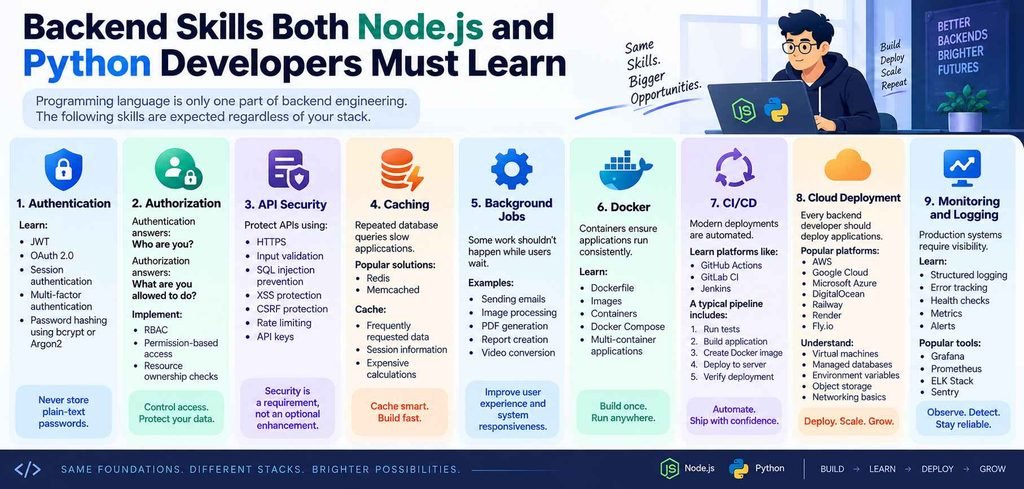
Backend Skills Both Node.js and Python Developers Must Learn
Programming language is only one part of backend engineering.
The following skills are expected regardless of your stack.
Authentication
Learn:
- JWT
- OAuth 2.0
- Session authentication
- Multi-factor authentication
- Password hashing using bcrypt or Argon2
Never store plain-text passwords.
Authorization
Authentication answers:
Who are you?
Authorization answers:
What are you allowed to do?
Implement:
- Role-Based Access Control (RBAC)
- Permission-based access
- Resource ownership checks
API Security
Protect APIs using:
- HTTPS
- Input validation
- SQL injection prevention
- XSS protection
- CSRF protection
- Rate limiting
- API keys
Security is a requirement, not an optional enhancement.
Caching
Repeated database queries slow applications.
Popular caching solutions include:
- Redis
- Memcached
Cache:
- Frequently requested data
- Session information
- Expensive calculations
Background Jobs
Some work shouldn’t happen while users wait.
Examples include:
- Sending emails
- Image processing
- PDF generation
- Report creation
- Video conversion
Background workers improve user experience and system responsiveness.
Docker
Containers ensure applications run consistently.
Learn:
- Dockerfile
- Images
- Containers
- Docker Compose
- Multi-container applications
Docker knowledge is expected in many backend roles.
CI/CD
Modern deployments are automated.
Learn platforms like:
- GitHub Actions
- GitLab CI
- Jenkins
A typical pipeline includes:
- Run tests
- Build application
- Create Docker image
- Deploy to server
- Verify deployment
Cloud Deployment
Every backend developer should deploy applications.
Popular platforms include:
- AWS
- Google Cloud
- Microsoft Azure
- DigitalOcean
- Railway
- Render
- Fly.io
Understand:
- Virtual machines
- Managed databases
- Environment variables
- Object storage
- Networking basics
Monitoring and Logging
Production systems require visibility.
Learn:
- Structured logging
- Error tracking
- Health checks
- Metrics
- Alerts
Popular tools include:
- Grafana
- Prometheus
- ELK Stack
- Sentry
Node.js vs Python: Detailed Comparison
| Category | Node.js | Python |
|---|---|---|
| Learning Curve | Moderate | Easy |
| Syntax | JavaScript | Clean and readable |
| Performance | Excellent | Good |
| Async Support | Native | Excellent (FastAPI/asyncio) |
| AI Development | Weak | Outstanding |
| REST APIs | Excellent | Excellent |
| Enterprise Apps | Excellent | Excellent |
| Startups | Very Popular | Popular |
| Microservices | Excellent | Excellent |
| Real-time Applications | Excellent | Good |
| Machine Learning | Limited | Industry Standard |
| Community | Massive | Massive |
| Library Ecosystem | Huge (npm) | Huge (PyPI) |
| Hiring Demand | Very Strong | Very Strong |
Which One Should You Choose?
There isn’t a universally correct answer.
Choose based on where you want your career to go.
Choose Node.js if you want to:
- Become a full-stack JavaScript developer
- Build SaaS products
- Create chat or collaboration apps
- Work in startup environments
- Build real-time applications
- Share code between frontend and backend
Choose Python if you want to:
- Work with AI or machine learning
- Build data-intensive applications
- Automate business workflows
- Develop enterprise software
- Enter research or scientific computing
- Combine backend development with analytics
12-Month Backend Developer Learning Plan
| Month | Focus |
|---|---|
| 1 | Programming fundamentals |
| 2 | Git, HTTP, APIs |
| 3 | SQL and database design |
| 4 | Node.js or Python basics |
| 5 | Express, Django, or FastAPI |
| 6 | Authentication and authorization |
| 7 | Advanced database concepts and ORM |
| 8 | Docker and deployment |
| 9 | Redis, caching, background jobs |
| 10 | Testing and CI/CD |
| 11 | Cloud deployment and monitoring |
| 12 | Build a complete portfolio and prepare for interviews |
Backend Portfolio Roadmap
Recruiters care more about what you’ve built than the number of tutorials you’ve watched.
A strong portfolio might include:
Beginner Projects
- Notes API
- Blog backend
- To-do application
- URL shortener
- Authentication service
Intermediate Projects
- E-commerce backend
- Inventory management system
- Expense tracker
- Learning management system
- Job board API
Advanced Projects
- Ride-sharing backend
- Social media platform
- Video streaming backend
- Multi-tenant SaaS platform
- Event booking system
- Payment gateway integration
- Notification service using queues
- Analytics dashboard backend
For each project, include:
- Authentication
- Role-based authorization
- Database relationships
- Validation
- Logging
- Docker support
- API documentation
- Unit and integration tests
- CI/CD pipeline
- Live deployment
Common Mistakes Beginners Make
Avoid these pitfalls:
- Jumping between languages every few weeks.
- Memorizing syntax without understanding programming concepts.
- Skipping SQL because ORMs “handle everything.”
- Ignoring Git until job interviews.
- Avoiding deployment and only running projects locally.
- Building only CRUD applications with no real-world features.
- Neglecting testing and error handling.
- Copy-pasting code without understanding it.
- Chasing every new framework instead of mastering fundamentals.
- Waiting until they feel “ready” before applying for internships or junior roles.
Frequently Asked Questions
Is Node.js faster than Python?
Generally, yes. Node.js often delivers better performance for I/O-heavy and real-time workloads because of its event-driven, non-blocking architecture. However, overall application performance depends on database design, caching, architecture, and infrastructure as much as language choice.
Is Python easier to learn than Node.js?
For most beginners, yes. Python’s syntax is simple and readable, allowing new developers to focus on programming concepts instead of language quirks. Node.js requires learning JavaScript’s asynchronous programming model, which can feel more challenging at first.
Can I learn both Node.js and Python?
Yes. After mastering one language and backend framework, learning the other is significantly easier because concepts like HTTP, REST APIs, databases, authentication, deployment, and testing transfer across ecosystems.
Which has more jobs?
Both technologies have strong demand. Node.js is common in startups, SaaS companies, and full-stack JavaScript teams, while Python is widely used in enterprise software, automation, AI-driven products, and data platforms. Your location and target industry will influence which appears more often in job listings.
Is backend development still a good career with AI?
Absolutely. AI can generate boilerplate code, but companies still need engineers who can design architectures, secure APIs, optimize databases, troubleshoot production issues, and make informed technical decisions. Those skills remain difficult to automate.
Do I need a computer science degree?
No. Many backend developers are self-taught or have degrees in unrelated fields. Employers typically prioritize demonstrable skills, real-world projects, problem-solving ability, and interview performance over formal education alone.
Should I learn Docker before applying for jobs?
You don’t need to master Docker before your first application, but understanding containerization and being able to package your projects with Docker gives you a meaningful advantage over candidates who only develop locally.
Which framework is best for beginners?
- Node.js: Express.js offers a straightforward introduction, while NestJS is an excellent next step for learning scalable architecture.
- Python: Flask is ideal for understanding backend fundamentals, Django is productive for feature-rich applications, and FastAPI is a strong choice for modern API development.
Final Practical Takeaways
Choosing between Node.js and Python is less about finding a “winner” and more about aligning your learning path with your goals.
If you want one language across both frontend and backend, enjoy building interactive web products, or plan to work in startups, Node.js is a compelling choice.
If you’re interested in AI, automation, data-heavy systems, or enterprise applications, Python provides exceptional versatility.
Regardless of the language you choose, the roadmap to becoming a professional backend developer is remarkably consistent:
- Master programming fundamentals.
- Understand HTTP, networking, and API design.
- Become comfortable with SQL and database modeling.
- Learn one backend framework deeply.
- Build increasingly complex real-world projects.
- Add production skills such as Docker, caching, testing, CI/CD, cloud deployment, monitoring, and security.
- Publish your work, document it well, and continuously improve based on feedback.
A developer who deeply understands backend engineering principles will always have an easier time switching languages than someone who only memorizes framework syntax. Focus on building strong fundamentals, and both Node.js and Python can lead to a rewarding backend development career.