
- Introduction
- 1. What Is Prompt Engineering?
- Common techniques
- 2. Why Is Prompt Engineering Relevant in 2026?
- A. AI is used across different industries
- B. Better models still need clear objectives
- C. AI workflows are becoming more sophisticated
- D. Human judgment remains important
- 3. What Are the Benefits of Learning Prompt Engineering?
- 4. Prompt Engineering vs. Other AI Skills
- 5. Career Opportunities: What Can You Do With Prompt Engineering?
- Is “prompt engineer” a sustainable job title?
- 6. Will AI Replace Prompt Engineers?
- 7. Graphs: Understanding the Value of AI Skills
- Graph 1: A layered view of AI skills
- Building an AI skill set
- Graph 2: How prompt engineering connects to other skills
- A qualitative comparison
- 8. How to Learn Prompt Engineering in 2026: A Practical Roadmap
- A 4-week beginner roadmap
- 1- Week 1: Understand AI and basic prompting
- 2- Week 2: Practice structured prompts
- 3- Week 3: Learn evaluation and verification
- 4- Week 4: Complete a practical project
- Beginner project ideas
- 9. What Tools Should You Use to Practice?
- 10. Common Mistakes Beginners Should Avoid
- 11. Who Should Learn Prompt Engineering?
- Conclusion: Should You Learn Prompt Engineering in 2026?
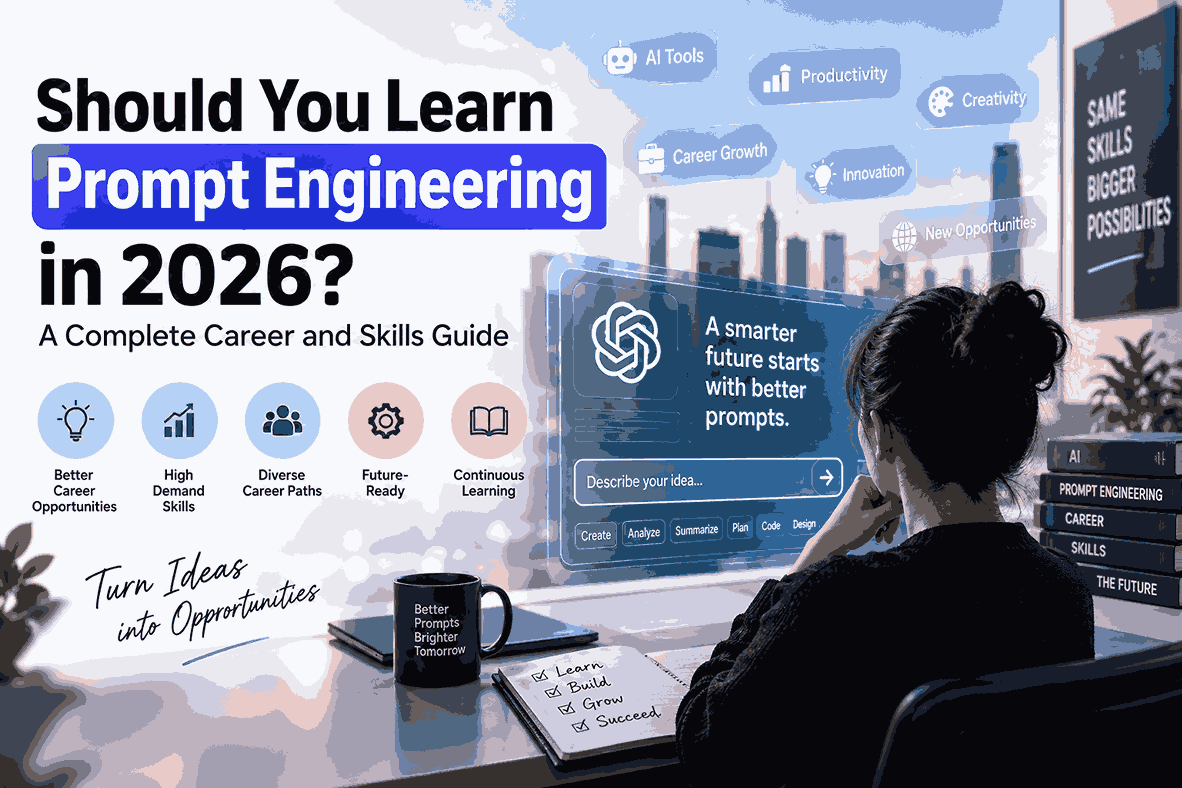
Introduction
Artificial intelligence (AI) has become an important part of education, software development, business operations, content creation, research, and everyday productivity. Tools powered by large language models (LLMs) can write text, generate code, analyze documents, summarize information, and assist with complex tasks. However, the quality of their output often depends on how effectively people communicate with them.
This has brought attention to a skill known as prompt engineering: the practice of designing, testing, and refining instructions given to AI systems to achieve useful, accurate, and consistent results.
But as AI technology advances, an important question arises: Should you learn prompt engineering in 2026, or is it becoming an outdated skill?
The answer depends on what you want to accomplish. Prompt engineering can be valuable for students, professionals, developers, entrepreneurs, researchers, and people exploring AI careers. However, learning to write prompts alone may not be enough to build a long-term career. Its value is increasingly connected to broader skills such as critical thinking, domain expertise, programming, data analysis, and AI workflow development.
This article examines what prompt engineering involves, why it matters in 2026, its career applications, its limitations, and how to learn it effectively.
1. What Is Prompt Engineering?
Prompt engineering is the process of creating and improving instructions that guide an AI model toward a desired response.
A prompt can be a simple question, a detailed set of instructions, or a structured specification that includes context, examples, constraints, and an expected output format.
For example, consider two prompts:
Basic prompt
“Explain digital marketing.”
Structured prompt
“Act as a digital marketing instructor. Explain digital marketing to a beginner in approximately 300 words. Cover SEO, social media, email marketing, and paid advertising. Give one practical example for each, use simple language, and finish with five revision questions.”
The second prompt communicates the audience, role, scope, format, and desired outcome. This gives the AI more information about what a useful answer should contain.
However, prompt engineering is not simply about writing longer instructions. A short, precise prompt can work better than a lengthy one. The objective is to provide the information the model needs without adding unnecessary complexity.
Common techniques
- Context setting: Providing relevant background information.
- Role prompting: Asking the model to respond from a particular professional perspective.
- Task decomposition: Breaking a complicated request into smaller steps.
- Few-shot prompting: Providing examples of the desired output.
- Output constraints: Specifying length, structure, tone, or format.
- Iterative refinement: Testing a response and improving the prompt.
- Grounding: Supplying relevant documents or data so the answer can be based on specific information.
In more advanced applications, prompt engineering can also involve structured outputs, tool use, retrieval systems, and evaluations of AI-generated results.
2. Why Is Prompt Engineering Relevant in 2026?
The role of prompt engineering has evolved alongside AI systems. Earlier conversations about the skill often focused on discovering clever phrases or special prompt formulas. In 2026, the more useful perspective is to treat prompting as part of a broader process of interacting with, evaluating, and building systems around AI.
Several developments help explain its continuing relevance.
A. AI is used across different industries
AI assistants are used for tasks such as drafting emails, summarizing reports, explaining technical concepts, generating software code, and organizing information.
People who can define a task clearly, supply appropriate context, and evaluate the output can often make more effective use of these tools.
B. Better models still need clear objectives
More capable models can interpret natural language and handle complex instructions, but they cannot automatically know every user’s priorities, business rules, or intended audience.
For example, asking an AI to “analyze sales” is different from asking it to identify month-over-month revenue changes, segment customers by purchase frequency, and explain which findings require further investigation.
C. AI workflows are becoming more sophisticated
AI applications increasingly combine language models with documents, databases, software tools, and automated processes.
In these situations, prompting is one component of a larger workflow. The quality of the result can also depend on data quality, tool selection, permissions, system design, and evaluation.
D. Human judgment remains important
AI-generated responses can contain factual errors, unsupported assumptions, outdated information, or inappropriate recommendations.
The ability to verify results and recognize limitations is therefore an important complement to prompt-writing skills.
3. What Are the Benefits of Learning Prompt Engineering?
Learning prompt engineering can provide practical benefits even if you never become an AI engineer.
1. Improved productivity
You can use AI to draft documents, summarize lengthy material, organize ideas, create outlines, and automate parts of repetitive work. Clear instructions can reduce the need for repeated corrections.
2. More effective learning
Students can ask AI to explain difficult concepts at different levels, generate practice questions, compare theories, and provide feedback on their understanding. They should still verify important information and complete their own academic work.
3. Support for coding and technical work
Developers can use prompts to explain unfamiliar code, generate test cases, identify possible bugs, and explore implementation approaches. Technical knowledge is essential for checking whether the output actually works.
4. Business and entrepreneurial applications
Business owners can experiment with AI-assisted customer support, marketing drafts, product research, and internal documentation. Successful implementation requires attention to customer privacy, accuracy, and business requirements.
These benefits are not guaranteed simply by knowing prompting techniques. They depend on choosing appropriate tasks, using suitable tools, and checking the results.
4. Prompt Engineering vs. Other AI Skills
One of the most important decisions for a learner in 2026 is how much time to devote to prompt engineering compared with other AI-related skills.
Prompting can be useful on its own, but it also supports more advanced areas of AI work.
| Skill | What you learn | Practical application |
|---|---|---|
| Prompt engineering | Writing and refining AI instructions | Better outputs from AI assistants |
| Python programming | Writing code and working with data | AI applications, automation, data processing |
| Data analysis | Interpreting datasets and identifying patterns | Business reporting and decision support |
| AI automation | Connecting AI to tools and workflows | Repetitive task automation |
| Machine learning | Training, evaluating, and understanding models | Predictive systems and applied AI |
| AI evaluation | Testing reliability, accuracy, and performance | Quality assurance for AI products |
| Domain expertise | Understanding a specific industry or profession | Applying AI to real problems in that field |
The skills serve different purposes. A marketing professional may benefit from prompt engineering and analytics, while an aspiring AI application developer may also need programming, APIs, and software engineering.
The key distinction: Prompt engineering helps you communicate with AI. Other skills help you build systems, interpret results, and solve problems that extend beyond a single conversation.
5. Career Opportunities: What Can You Do With Prompt Engineering?
Prompt engineering can contribute to several career paths, but it is important to distinguish between a skill used within a job and a dedicated job title.
Some organizations may recruit for roles specifically involving prompt design or AI interaction. Others include these responsibilities within software engineering, product development, marketing, research, consulting, or operations.
The table below describes possible applications, not guaranteed vacancies or salary outcomes.
| Career path | How prompting may be used | Additional skills to consider |
|---|---|---|
| AI application developer | Designing instructions for AI-powered features | Python or JavaScript, APIs, software development |
| AI workflow specialist | Structuring prompts within automated processes | Automation platforms, data handling, testing |
| Content professional | Drafting and revising content | Editing, research, audience understanding, SEO |
| Data analyst | Explaining findings and generating analysis code | SQL, statistics, visualization |
| AI product manager | Defining AI feature behavior and acceptance criteria | Product management, user research, evaluation |
| AI researcher or engineer | Testing model behavior and developing applications | Mathematics, programming, machine learning |
| Domain-specific consultant | Applying AI to industry problems | Relevant industry expertise, process design |
Is “prompt engineer” a sustainable job title?
It is difficult to predict how many dedicated prompt-engineering positions will exist in the future. Job titles and responsibilities can change as AI tools become easier to use and organizations redesign their workflows.
Some prompting tasks may become increasingly automated or incorporated into standard software interfaces. At the same time, organizations still need people who can define requirements, assess outputs, handle exceptions, and integrate AI into real processes.
Therefore, it is useful to approach prompt engineering as a transferable capability rather than relying entirely on one job title.
6. Will AI Replace Prompt Engineers?
This question is better understood as a question about how AI may change the work involved in prompting.
Modern AI assistants can already help users rewrite prompts, generate alternatives, and identify missing context. As these capabilities improve, some routine prompt-writing tasks may require less manual effort.
However, using AI to generate a prompt does not automatically solve the underlying problem.
Someone still needs to determine:
- What outcome is actually required.
- Which information the model should use.
- What errors would matter most.
- How success should be measured.
- When a human needs to review the result.
- Whether the workflow complies with privacy and other requirements.
For instance, an AI system may generate a customer-service response that sounds professional but incorrectly describes a refund policy. The important skill is not merely creating a polished prompt; it is designing a process that uses the correct policy information and checks the response before sending it.
The future of prompt-related work will likely depend on the combination of AI capabilities, organizational needs, and the complexity of the tasks involved. The exact employment impact remains uncertain.
7. Graphs: Understanding the Value of AI Skills
The following graphs are conceptual illustrations to help explain how different skills fit together. They are not survey results, employment statistics, salary data, or forecasts.
Graph 1: A layered view of AI skills
Building an AI skill set
Illustrative learning model — from foundational skills to applied expertise
Layer 4: Applied expertise
Domain knowledge · Real-world problem solving
Layer 3: AI workflows
Automation · APIs · Tool integration
Layer 2: Technical and analytical skills
Programming · Data · Testing · Evaluation
Layer 1: AI literacy and prompting
Clear instructions · Context · Output review
Prompt engineering is a useful foundation, but it is only one part of a broader skill set.
This model is not a strict prerequisite ladder. A writer, for example, may develop strong AI literacy and domain expertise without becoming a programmer. A software developer may build on prompting by learning APIs and evaluation methods.
Graph 2: How prompt engineering connects to other skills
A qualitative comparison
Illustrative relationship to AI-assisted work, not a measured score
Prompt engineering
Prompting + domain expertise
Prompting + technical skills + evaluation
These bars illustrate how combining complementary skills can expand the kinds of tasks someone is equipped to handle. They do not represent measured productivity or hiring outcomes.
The broader lesson is that learning to prompt is a starting point. The value of that skill depends on the problems you can solve with it.
8. How to Learn Prompt Engineering in 2026: A Practical Roadmap
You do not need to begin with expensive courses or advanced mathematics. A structured approach using everyday AI tasks can help you develop useful habits.
A 4-week beginner roadmap
Suggested schedule: 30–60 minutes a day, adjusted to your availability.
1- Week 1: Understand AI and basic prompting
Learn what language models do, where they can fail, and how context, audience, constraints, and examples affect responses.
Practice: Rewrite vague questions into clear, specific instructions.
2- Week 2: Practice structured prompts
Experiment with examples, task decomposition, output formats, and follow-up instructions.
Practice: Create a reusable prompt for a task you perform regularly.
3- Week 3: Learn evaluation and verification
Compare responses, test edge cases, identify hallucinations, and learn to check important claims against reliable sources.
Practice: Build a small checklist for judging AI output quality.
4- Week 4: Complete a practical project
Apply your skills to a real task and document your prompt, results, limitations, and improvements.
Practice: Produce a portfolio-ready demonstration of an AI-assisted workflow.
Beginner project ideas
Choose a project that connects to something you already do:
- Build an AI study assistant that creates quizzes from your notes.
- Create a content-planning workflow for a blog or social media account.
- Develop a document summarizer with clear accuracy checks.
- Use AI to help analyze a small dataset, then independently verify the calculations.
- Create a customer-support draft generator using a supplied set of example policies.
A project gives you something more concrete to discuss than a list of prompting techniques. It demonstrates that you can apply AI thoughtfully to a defined problem.
9. What Tools Should You Use to Practice?
Start with tools you can access rather than trying to learn every AI platform at once.
| Tool category | What to practice |
|---|---|
| AI chat assistants | Prompt design, context, iterative refinement |
| Document-based AI tools | Summarizing and answering questions from supplied material |
| Coding assistants | Code explanation, debugging, test generation |
| Automation platforms | Connecting AI steps to repeatable workflows |
| Programming environments | Working with model APIs and structured data |
You can begin with ChatGPT and explore its capabilities through everyday tasks. As you become more comfortable, experiment with different models and compare how they respond to the same instructions.
The goal is not to memorize prompts for one particular platform. It is to understand principles that transfer across tools.
10. Common Mistakes Beginners Should Avoid
Mistake 1: Believing that longer prompts are always better. Unnecessary instructions can make a task harder to interpret. Prioritize clarity and relevant context.
Mistake 2: Trusting every AI response. Fluent writing is not proof of accuracy. Verify important claims, calculations, and references.
Mistake 3: Memorizing prompt templates without understanding them. Templates are starting points, not universal solutions. Adapt them to the task.
Mistake 4: Ignoring privacy. Avoid entering confidential business information, personal data, passwords, or sensitive documents into AI tools without appropriate authorization and safeguards.
Mistake 5: Learning prompting without building anything. Practical projects help you discover what works, what fails, and which complementary skills you need.
Mistake 6: Assuming a certificate guarantees employment. A certificate can demonstrate learning, but employers may also look for relevant experience, technical abilities, communication, and evidence of solving real problems.
11. Who Should Learn Prompt Engineering?
Prompt engineering can be useful for people with different backgrounds, but their learning priorities will vary.
| If you are a… | A useful learning direction |
|---|---|
| Student | AI literacy, research verification, study workflows |
| Content creator | Prompting, editing, audience research, content strategy |
| Business owner | Workflow improvement, privacy, process automation |
| Software developer | Prompting, APIs, evaluation, software engineering |
| Job seeker | Prompting plus skills relevant to a target occupation |
| AI enthusiast | Prompting, model behavior, experimentation, project development |
You do not need to become a full-time AI specialist to benefit from the skill. Even learning how to give better instructions and verify responses can improve your ability to work with AI tools.
Conclusion: Should You Learn Prompt Engineering in 2026?
Yes, learning prompt engineering can be worthwhile in 2026, especially when you treat it as a practical AI skill rather than a guaranteed standalone career.
It can help you communicate more effectively with AI systems, improve everyday workflows, and develop a foundation for exploring more advanced applications. Its usefulness is not limited to software developers or people pursuing dedicated AI roles.
However, prompt engineering alone does not guarantee employment, high earnings, or long-term career security. AI tools are evolving, and some routine prompting tasks may become easier to automate. A sustainable learning strategy should therefore combine prompting with critical thinking, domain knowledge, evaluation, and—where relevant—programming, data analysis, or automation.
If you are starting from zero, spend a few weeks practicing with real tasks, then choose a direction that matches your interests. Build a small project, test its results, and learn the additional skills needed to improve it.
The most useful question is not simply, “Can I write a good AI prompt?” It is: “Can I use AI responsibly and effectively to solve a real problem?”
That is the broader capability worth developing in 2026 and beyond.


One thought on “Should You Learn Prompt Engineering in 2026? A Complete Career and Skills Guide”