
Technical writing is the art of explaining complex information in a way that’s easy to understand. Companies need clear documentation for software, hardware, APIs, medical devices, engineering products, and business processes. As technology continues to grow, the demand for skilled technical writers has never been higher.
The best part? You don’t necessarily need a computer science degree. If you can research well, write clearly, and understand technical concepts, you can build a successful career as a technical writer.
Whether you’re a student, career changer, engineer, or freelance writer, technical writing offers flexible work opportunities, remote jobs, and excellent earning potential.
- What Does a Technical Writer Do?
- Types of Technical Writing
- Software Documentation
- API Documentation
- Knowledge Base Articles
- Business Documentation
- Medical Writing
- Engineering Documentation
- Product Documentation
- Skills Every Technical Writer Needs
- Excellent Writing Skills
- Research Skills
- Technical Understanding
- Communication Skills
- Editing Skills
- Visual Communication
- Step-by-Step Roadmap to Learn Technical Writing
- Step 1: Improve Your Writing Fundamentals
- Step 2: Learn Documentation Principles
- Step 3: Learn Markdown
- Step 4: Understand Basic HTML and CSS
- Step 5: Learn Git and GitHub
- Step 6: Learn Technical Topics
- Step 7: Practice Writing Every Day
- Essential Tools Every Technical Writer Should Learn
- Writing Tools
- Documentation Platforms
- Collaboration Tools
- Version Control
- Diagram Tools
- Screenshot Tools
- Learn Basic Programming (Without Becoming a Developer)
- Build a Technical Writing Portfolio
- Best Practice Projects
- Learn Information Architecture
- Understand Your Audience
- Beginners
- Intermediate Users
- Advanced Users
- Learn API Documentation Basics
- Improve Your Editing Process
- Certifications That Can Help
- Freelancing vs Full-Time Technical Writing
- Freelancing
- Full-Time Employment
- Where to Find Paid Technical Writing Work
- Freelance Platforms
- Job Boards
- Direct Outreach
- How Much Do Technical Writers Earn?
- Common Mistakes Beginners Make
- 90-Day Learning Plan
- Month 1: Build the Foundation
- Month 2: Develop Technical Skills
- Month 3: Build a Portfolio and Start Earning
- Frequently Asked Questions
- Can I become a technical writer without a technical degree?
- Is coding required?
- How long does it take to learn technical writing?
- What industries hire technical writers?
- Can technical writing be a remote career?
- Final Thoughts
What Does a Technical Writer Do?
Technical writers create documentation that helps users understand products, software, or processes.
Common responsibilities include:
- Writing user manuals
- Creating installation guides
- Developing API documentation
- Writing knowledge base articles
- Preparing software documentation
- Creating Standard Operating Procedures (SOPs)
- Writing troubleshooting guides
- Editing technical documents
- Collaborating with developers and engineers
- Maintaining documentation updates
Your job is to bridge the gap between technical experts and everyday users.
Types of Technical Writing
Technical writing isn’t limited to software documentation. There are many specialized fields.
Software Documentation
- User guides
- Feature documentation
- Release notes
- Admin manuals
API Documentation
- REST API documentation
- SDK guides
- Authentication instructions
- Endpoint references
Knowledge Base Articles
- FAQs
- Help centers
- Troubleshooting articles
Business Documentation
- SOPs
- Internal documentation
- Training manuals
- Process documents
Medical Writing
- Clinical documentation
- Device manuals
- Regulatory documents
Engineering Documentation
- Equipment manuals
- Maintenance guides
- Safety documentation
Product Documentation
- User onboarding
- Product tutorials
- Configuration guides
Skills Every Technical Writer Needs
Excellent Writing Skills
Your writing should be:
- Clear
- Concise
- Accurate
- Well-organized
- Reader-focused
Avoid unnecessary jargon unless your audience expects it.
Research Skills
You’ll constantly learn new technologies and industries.
Good researchers know how to:
- Read documentation
- Ask smart questions
- Verify facts
- Understand workflows
Technical Understanding
You don’t need to become a software engineer, but you should understand:
- Basic programming concepts
- Software development lifecycle
- Databases
- APIs
- Cloud computing basics
Communication Skills
Technical writers work with:
- Developers
- Designers
- Product managers
- QA engineers
- Customers
Strong communication saves countless hours.
Editing Skills
Good documentation goes through multiple revisions.
Learn to:
- Remove unnecessary words
- Improve readability
- Check consistency
- Fix grammar
- Verify accuracy
Visual Communication
Modern documentation includes:
- Diagrams
- Flowcharts
- Screenshots
- Tables
- Infographics
Simple visuals often explain concepts better than long paragraphs.
Step-by-Step Roadmap to Learn Technical Writing
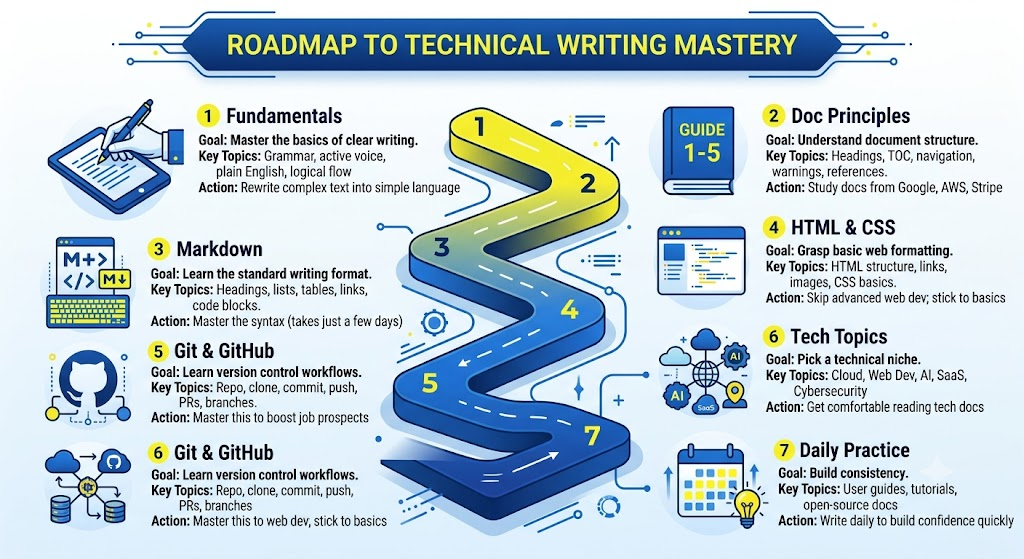
Step 1: Improve Your Writing Fundamentals
Before writing technical documentation, master the basics.
Focus on:
- Grammar
- Sentence structure
- Active voice
- Plain English
- Logical organization
Practice rewriting complex paragraphs into simpler language.
Step 2: Learn Documentation Principles
Understand how technical documents are structured.
Study:
- Headings
- Navigation
- Table of contents
- Numbered procedures
- Warning notes
- Tips
- References
Read documentation from companies like Microsoft, Google, Stripe, GitHub, and AWS.
Step 3: Learn Markdown
Markdown is the most widely used writing format for technical documentation.
Learn:
- Headings
- Lists
- Tables
- Links
- Images
- Code blocks
- Quotes
You can master Markdown in just a few days.
Step 4: Understand Basic HTML and CSS
Many documentation platforms use HTML.
Learn:
- HTML structure
- Links
- Tables
- Images
- Lists
- CSS basics
You don’t need advanced web development.
Step 5: Learn Git and GitHub
Many documentation teams use Git.
Understand:
- Repository
- Clone
- Commit
- Push
- Pull request
- Branch
- Merge
This skill significantly improves your job prospects.
Step 6: Learn Technical Topics
Choose one technical area.
Examples include:
- Cloud computing
- Web development
- Cybersecurity
- Networking
- AI
- SaaS products
- Databases
Become comfortable reading technical documentation.
Step 7: Practice Writing Every Day
Consistency matters.
Ideas include:
- Rewrite software documentation
- Create user guides
- Explain Git commands
- Document open-source projects
- Write installation tutorials
Daily practice builds confidence quickly.
Essential Tools Every Technical Writer Should Learn
Writing Tools
- Google Docs
- Microsoft Word
- Notion
- Obsidian
Documentation Platforms
- Confluence
- GitBook
- ReadMe
- Docusaurus
- MkDocs
Collaboration Tools
- Jira
- Trello
- Slack
- Microsoft Teams
Version Control
- Git
- GitHub
- GitLab
Diagram Tools
- Draw.io
- Lucidchart
- Figma
Screenshot Tools
- Snagit
- Greenshot
- ShareX
Learn Basic Programming (Without Becoming a Developer)
You don’t need to build software, but understanding code is extremely valuable.
Start with:
- Variables
- Functions
- Loops
- APIs
- JSON
- HTTP requests
Python or JavaScript are excellent beginner choices.
Build a Technical Writing Portfolio
A portfolio is more important than certifications.
Include:
- Installation guides
- User manuals
- API documentation
- Tutorials
- Troubleshooting articles
- Knowledge base articles
- Product walkthroughs
Aim for 10–15 polished samples across different formats.
Best Practice Projects
Project ideas include:
- Document an open-source project
- Write a beginner Git guide
- Create Windows installation instructions
- Build a software onboarding guide
- Explain Docker basics
- Write a Notion user manual
- Create troubleshooting documentation
- Develop a REST API guide
- Build FAQ documentation
- Document a mobile app
These projects demonstrate practical skills to employers and clients.
Learn Information Architecture
Great documentation isn’t just well-written—it is easy to navigate.
Understand:
- Content hierarchy
- Navigation
- Cross-linking
- Search optimization
- Categories
- Taxonomy
Well-organized documentation reduces user frustration and support requests.
Understand Your Audience
Technical writers tailor documentation to different readers.
Examples include:
Beginners
Need simple explanations and step-by-step instructions.
Intermediate Users
Want efficient workflows and practical examples.
Advanced Users
Expect detailed references, edge cases, and technical depth.
Always write with a specific audience in mind.
Learn API Documentation Basics
API documentation is among the highest-paying areas of technical writing.
Core concepts to learn:
- HTTP methods (GET, POST, PUT, DELETE)
- Endpoints
- Authentication
- Parameters
- Request bodies
- Response examples
- Error codes
- Rate limits
Practice documenting a public API to build confidence.
Improve Your Editing Process
Professional technical writers rarely publish a first draft.
Use an editing checklist:
- Verify technical accuracy.
- Remove unnecessary words.
- Check grammar and spelling.
- Ensure formatting consistency.
- Test every instruction yourself.
- Confirm screenshots match the latest interface.
- Validate all links and references.
Certifications That Can Help
While a portfolio matters more, certifications can strengthen your profile.
Popular options include:
- Google Technical Writing courses
- API documentation courses
- Coursera technical writing programs
- Udemy technical writing courses
- Society for Technical Communication (STC) training
- Write the Docs community workshops
Choose courses that include practical projects rather than only theory.
Freelancing vs Full-Time Technical Writing
Freelancing
Pros
- Flexible schedule
- Multiple clients
- Higher earning potential
- Work from anywhere
Cons
- Inconsistent income
- Client acquisition
- Self-marketing
- Administrative work
Full-Time Employment
Pros
- Stable salary
- Employee benefits
- Structured career growth
- Team collaboration
Cons
- Less flexibility
- Fixed working hours
- Limited project variety
Many writers begin with a full-time role and later transition into freelance consulting.
Where to Find Paid Technical Writing Work
Freelance Platforms
- Upwork
- Fiverr
- Contra
- Toptal (experienced professionals)
Job Boards
- LinkedIn Jobs
- Indeed
- Wellfound
- Remote OK
- We Work Remotely
Direct Outreach
Reach out to:
- SaaS startups
- Software companies
- Open-source organizations
- AI startups
- Cloud service providers
- Cybersecurity firms
A strong portfolio often opens more doors than a long résumé.
How Much Do Technical Writers Earn?
Earnings vary by experience, specialization, and location.
Typical ranges are:
| Experience | Approximate Annual Income (US) |
|---|---|
| Beginner | $45,000–$65,000 |
| Intermediate | $65,000–$90,000 |
| Senior | $90,000–$130,000+ |
| API Documentation Specialist | $110,000–$160,000+ |
Freelancers commonly charge by the hour or project. Experienced specialists in API documentation, cloud computing, and cybersecurity often command premium rates.
Common Mistakes Beginners Make
Avoid these pitfalls:
- Writing long, complicated sentences
- Assuming readers have prior knowledge
- Skipping step-by-step testing
- Using inconsistent terminology
- Ignoring document structure
- Publishing without peer review
- Building no portfolio before applying for jobs
- Learning tools without practicing real documentation
90-Day Learning Plan
Month 1: Build the Foundation
- Improve grammar and clarity
- Learn Markdown
- Study documentation examples
- Practice rewriting technical content
- Learn basic HTML
Month 2: Develop Technical Skills
- Learn Git and GitHub
- Understand APIs and JSON
- Create tutorials and user guides
- Explore documentation platforms
- Learn basic programming concepts
Month 3: Build a Portfolio and Start Earning
- Publish 8–10 documentation samples
- Contribute to an open-source project
- Create a personal portfolio website
- Apply for internships and junior roles
- Pitch freelance clients
- Optimize your LinkedIn profile
Frequently Asked Questions
Can I become a technical writer without a technical degree?
Yes. Many successful technical writers come from backgrounds in English, journalism, education, science, customer support, or other non-engineering fields. A strong portfolio and the ability to explain technical concepts clearly are often more important than your degree.
Is coding required?
Not for most roles. However, understanding basic programming, APIs, Git, and software development concepts makes you more competitive and opens doors to higher-paying documentation work.
How long does it take to learn technical writing?
With consistent practice, you can build foundational skills in 2–3 months. Becoming job-ready with a solid portfolio typically takes 3–6 months, depending on your technical background and writing experience.
What industries hire technical writers?
Technical writers are employed across software, cloud computing, cybersecurity, healthcare, manufacturing, engineering, finance, telecommunications, education technology, and government sectors.
Can technical writing be a remote career?
Yes. Technical writing is one of the most remote-friendly professions. Many companies hire fully remote writers, and freelancers can work with clients around the world.
Final Thoughts
Technical writing combines communication, problem-solving, and technical knowledge into a career with strong long-term demand. You don’t need to be an expert programmer to succeed, but you do need curiosity, attention to detail, and a commitment to making complex information easy to understand.
Focus on learning the fundamentals, mastering modern documentation tools, building a portfolio with real-world projects, and continuously improving your technical knowledge. With consistent effort, you can transition from learning technical writing to earning from it through freelance projects, remote jobs, or full-time roles.