
Staring at a pristine, blank sketchbook page often triggers immediate mental paralysis. You open the cover intending to create something expressive, but the fear of ruining expensive paper with stiff lines freezes your hand. Practicing targeted daily sketchbook exercises to overcome creative block strips away the burden of perfection and replaces performance anxiety with fast, low-stakes creative momentum.
A sketchbook is not an exhibition gallery; it is a testing laboratory designed for messy visual experiments. When you treat your daily drawing routine as play rather than a test of raw talent, the resistance vanishes. Five field-tested exercises will get your pen moving, retrain your eye, and build an effortless daily drawing habit.

Why Daily Sketchbook Habits Defeat Creative Resistance
Creative block rarely stems from a genuine lack of ideas. Instead, it is almost always caused by an overactive inner critic demanding finished, portfolio-ready results from the very first stroke. When the stakes feel impossibly high, avoiding the drafting table becomes an easy defense mechanism.
Establishing bite-sized, time-boxed drawing routines breaks that paralysis by lowering cognitive friction. If you want structured guidance from working artists, reviewing curated pathways across the best Domestika illustration courses exposes you to studio veterans who prioritize daily doodling and visual research over stiff anatomical accuracy.
Regular sketching also sharpens the hand-eye reflexes required for commercial visual pipelines. Once you start generating spontaneous marks and loose textures, you might find ideas worth transforming into digital assets. When digitizing analog illustrations for design pitches, knowing how to use Canva’s AI background remover for clean graphics provides an efficient way to extract raw linework from textured paper backgrounds for client presentations and social layouts.
5 Daily Sketchbook Exercises to Overcome Creative Block
1. Blind Contour Drawing (5 Minutes)
Blind contour drawing is the ultimate antidote to overthinking. Pick any object in front of you—a crumpled coffee cup, a houseplant, or your non-dominant hand. Place your pen on the paper, look squarely at the object, and trace its edges with your eyes while moving your pen at the exact same speed.
The rule is non-negotiable: never look down at the page until you finish, and never lift your pen. The resulting sketch will look distorted and comical, and that is precisely the goal. By disconnecting your hand from your critical eye, you short-circuit perfectionism and train your brain to prioritize raw observation over mental assumptions.
2. Continuous Line Speed Runs (3 to 5 Minutes)
Continuous line drawing forces decisive mark-making and fluidity. Set a timer for three minutes, pick a subject with varied volumes, and sketch the entire form using a single, uninterrupted stroke.
Because you cannot lift the pen, you must draw through forms, loop back over previous contours, and vary your hand pressure to suggest weight. This exercise eliminates cautious, feathery “chicken scratching” and builds muscular confidence. Your lines immediately become bolder, more rhythmic, and visually expressive.
3. The Negative Space Inversion (10 Minutes)
When artists struggle with proportions, it is usually because the brain draws what it thinks an object looks like rather than what is actually there. The negative space inversion exercise forces a complete perceptual reset.
Find a complex subject with empty gaps such as the spaces between chair legs, scissors handles, or leafy branches. Instead of drawing the physical objects, outline and shade only the empty silhouettes around and between them. Focusing entirely on the surrounding empty space allows your subconscious to capture tricky angles and proportions accurately without second-guessing.
4. Random Shape Scribbles and Pareidolia (7 Minutes)
Pareidolia is the human tendency to spot familiar patterns and faces in random textures. You can turn this natural psychological quirk into an endless well of creative inspiration.
Close your eyes, drag your pen across the page in an energetic scribble, or drop a splash of loose, watery ink onto the paper and let it spread. Once the ink settles, rotate the page in different directions until a hidden silhouette emerges. Use a fine-liner pen to carve out eyes, limbs, quirky characters, or mechanical parts from the chaotic marks. This gamified exercise bypasses the blank-canvas dread and sparks spontaneous visual storytelling.
5. The 100-Thumbnail Grid Sprint (10 Minutes)
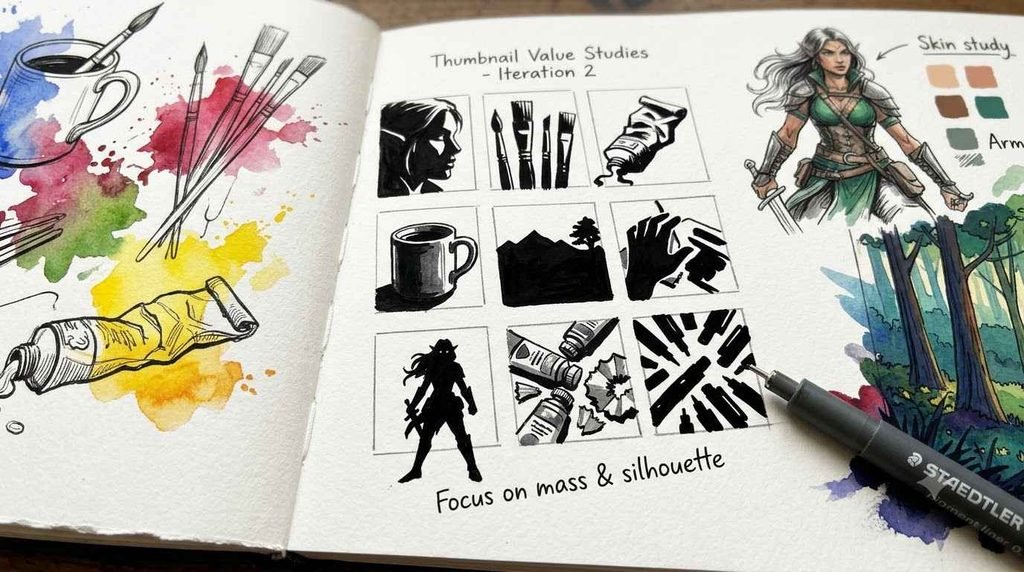
Divide a clean page into small, one-inch squares using a pencil and ruler. Challenge yourself to fill ten to twenty boxes in a single ten-minute burst with tiny, rapid-fire compositions.
Fill each square with abstract value patterns, silhouette concepts, lighting studies, or micro-landscapes. The tiny format prevents you from getting bogged down in microscopic details, forcing you to focus exclusively on visual weight, contrast, and balance. It is an exceptional warm-up that primes your brain for larger illustration projects.
Comparing the 5 Daily Sketchbook Exercises
| Exercise Name | Primary Focus | Time Commitment | Recommended Tool | Core Creative Benefit |
| Blind Contour | Pure observation | 5 minutes | Gel pen or rollerball | Destroys perfectionism instantly |
| Continuous Line | Line economy & rhythm | 3–5 minutes | Fountain pen or fineliner | Eliminates hesitant strokes |
| Negative Space | Spatial proportions | 10 minutes | Soft graphite (4B–6B) | Resets perceptual bias |
| Pareidolia Scribbles | Imagination & ideation | 7 minutes | Watered ink & brush pen | Unlocks spontaneous characters |
| Thumbnail Grid | Composition & value | 10 minutes | Chisel marker or charcoal | Sharpens visual hierarchy |
Practical Rules to Maintain Daily Sketchbook Consistency
Building a lasting creative routine is fundamentally an exercise in friction reduction. If your sketchbook sits packed in a backpack and your pens are scattered across the room, you will find excuses to skip your practice. Keep your notebook open on your desk with a reliable pen clipped directly to the cover.
Eliminate the eraser from your daily warm-up toolkit. The ability to erase invites self-censorship, prompting you to scrub away imperfect lines before an idea has room to develop. Working with permanent ink teaches you to accept unexpected marks, adapt on the fly, and incorporate accidental strokes into your composition.
Finally, date every single page you complete. Looking back through weeks of raw, unfiltered scribbles provides tangible evidence of your evolving visual taste and technical growth. Behavioral psychology studies on visual habit tracking and creative persistence If you want to expand your creative habits across broader formats, exploring top learning hubs on the best online course platforms will help you find mentors who celebrate personal sketchbook play alongside professional techniques.
Frequently Asked Questions
What type of sketchbook is best for daily exercises?
A medium-sized (A5), mixed-media sketchbook with paper weight between 160 and 200 GSM works best. It is compact enough to carry everywhere while handling ink washes, markers, and graphite without bleeding through pages.
How much time should I spend on daily sketching?
Ten to fifteen minutes per day is more than enough to maintain momentum. Consistency matters far more than duration; fifteen minutes of focused, daily mark-making builds stronger visual reflexes than an exhausting four-hour session once a month.
What should I do if I hate what I drew during an exercise?
Leave it on the page and resist the urge to tear out sheets. Turn the page immediately and start the next exercise. A sketchbook full of messy, imperfect failures is proof of an active, experimental artist at work.
Reignite Your Creative Spark
Overcoming creative block does not require waiting for a sudden bolt of artistic inspiration. It requires setting your tools on the desk, setting a five-minute timer, and making bold marks without worrying about the outcome. When you remove the pressure to produce masterpieces, your sketchbook transforms into what it was always meant to be: an inspiring playground for your curiosity.
Pick an exercise from this guide, open to a fresh page, press your pen to the paper, and start drawing today.